Showing posts with label Scotland. Show all posts

Monday, April 11, 2011

Isle of Skye: The thrilling conclusion

We woke early to enjoy our last day on the Isle of Skye. This is the beautiful view outside the hostel window in the village of Kyleakin.


We crossed this bridge that divides Isle of Skye from mainland Scotland.


It no longer charges a toll, but when it first opened, it was considered one of the most expensive roads in Europe. Our guide told us that at the time, she had to pay around £40 to cross the bridge in the coach bus. The villagers protested the fees through refusing to pay the tolls, and were ultimately successful.


This is Eileen Donan Castle, one of the most photographed sights in Scotland. The original castle dates back to the 13th century, though it had been demolished and rebuilt in the past century. It was first used as a defence against the Vikings, and later during the Jacobite Risings. It has also been the filming for many movies, perhaps most notably, the Highlander.


This is Ben Nevis, the highest mountain in all of the British Isles. With all the clouds, we weren't able to see the summit, which is over 1,300m above sea level. For comparison, the highest Rocky Mountain is around 4,400m above sea level.


After a few stops, we made it to Glencoe, the site of the notorious Massacre of Glencoe. After the Jacobite Risings, which aimed to reinstate James VII of Scotland as the British monarch, the highlanders were asked to swear an oath of allegiance to the new king and queen. The MacDonald of Glencoe clan were not quick in announcing their loyalty.


The Campbell clan arrived in Glencoe and spent two weeks as guests of the highland clan, dining and socialising with them, before massacring the clan. Thirty-eight were killed directly during the massacre, while the majority of the rest of them died shortly after having had all of their food and belongings burned. Our guide's moral of the story: Never trust a Campbell. (Apparently, this is a saying that many Scots have been taught. Let's hope it isn't true; I live with one!)


I had to add this photograph because I couldn't believe the price of gas here! I complain when the it costs more than about $1 per L, but here, it cost £1.369 per L. That's over $2 per L! I don't know how people afford to drive out here. It was even more in London.


This is the Glenfinnan Viaduct, which made me excited because of its appearance in the Harry Potter movies. Apparently, during the summer, it's possible to take a the Jacobite steam train (aka: Hogwarts Express) along the route.


We stopped to visit Hamish the Highland Cow in Perthshire. Our tour guide said he's a very famous highland cow and people come from far away to visit him (and it appears that many tours do, indeed, stop to say hello). My Scottish flatmates, however, have never heard of him, so I'm guessing it's just part of the tourism. He was cute anyway!


And that's the end of the MacBackpackers trip! The bus stopped at the Wallace Monument, which is just on the edge of campus, so our guide kindly dropped my flatmate and I off at the residences, where we said goodbye and headed back to the real world, full of classes, and readings and essays—oh my!

Sunday, April 10, 2011

Finally...Isle of Skye, part 2!

In the morning of the 19th of February, we woke up in the Isle of Skye and headed into the mountains.


Our first stop was Sligachan, where the river is said to be the tears of Scáthach. She was said to be a strong leader, who was challenged by the Irish warrior Cúchulainn. After days and days of fighting, they recognised that they couldn’t defeat each other. They ended up falling in love, but then Cúchulainn left to return to Ireland, causing Scáthach to cry. Her tears filled the river, and our guide gave us the moral of the story: Never trust an Irishman.


We were all advised to stick our faces in the water and we would have everlasting beauty and youth. I’m guessing the ice-cold water is just meant to freeze our faces into place forever and ever.


We continued into the cute town of Portree, where we stopped for pastries before moving on for our mountain hike.


I’m divided about my thoughts on this hike. On the one hand, I saw some of the most beautiful sights I’ve ever seen. On the other hand, it was slightly terrifying. We were essentially scaling the mountain during some parts, with a path about a foot wide. Exhilarating, nonetheless.


Once we all finally reached the top, we stopped for photos and turned around to take the same path back. While going up was scary, walking down was much worse.


There were sections where we had to drop a little bit to get to the next part of the path. There were also portions that had two places that looked like the path, and we couldn’t remember which one was the right one. In the end, though, we all made it down. I was just thankful to have been wearing Wellington boots, and not high heels like some of the girls.


Next, we drove to the westernmost point on the island. From there, our guide said, if we were able to see far enough, the next bit of land would be Canada. A couple months before, my sister visited Newfoundland and stood on the easternmost point and waved at me in the UK, so I made sure to return the gesture from here.


We continued our drive, passing lots of cute wee houses sporadically situated around the island. This is what many think of as the idyllic Scotland, all surrounded by wilderness and away from the cities.


The weather was very erratic. One moment we would feel warmth and sunshine, and then randomly, it would be raining. Though irritating, it meant we saw tons of rainbows.


And of course, tons of sheep.


Our final stop of the day was Faerie Glen. Up until this point, we saw tons of big hills, mountains, and lochs. Here, however, we saw it all again, but in miniature form.


Some of the faerie beliefs involve them tripping hikers and making their possessions go missing. It is said the entry to the faerie world is here, so many people leave gifts to the faeries in hopes they will treat them kindly.


Some of the sacrifices were rather eerie, such as piles of animal bones.


Most of the gifts, however, were small coins, hair elastics and flowers.


It’s said that if anybody removes items from Faerie Glen, whether it is the gifts or the nature, bad things will happen to them. Our tour guide insisted that every once in a while, they have people mailing sticks or stones to the MacBackpackers office, asking for them to return it to Faerie Glen.


That's it for now. I will have the last part up sometime in the next couple of days—I swear I will!

Monday, February 28, 2011

Nessie, where are you? Part 1 of my Highland adventure.

For some reason, I spent an entire semester here without visiting the highlands of this beautiful country. I knew I had to get there before I went home, and thus, I went on a MacBackpackers tour of Isle of Skye and the Highlands. 

When my flatmate Megan and I signed up, were informed that we had to meet the bus in Edinburgh at 7:45am. For some reason, it didn’t click that in order to be in Edinburgh at 7:45am, we’d have to be up at 5:15 and out the door by 6:00. Edinburgh, why must you be so far away?

Anyway, after patting myself on the back for being able to get us to the hotel without getting lost, we met the group and set off.

Our tour guide was named Ruthie, and she was amazing. She filled the bus with mostly Scottish tunes, some of which was quite mainstream pop music (for example, KT Tunstall and Amy Macdonald), while others were bagpipe-filled folk music or Celtic rock.


We drove out of Edinburgh, across the Forth Bridge, and into Fife, where we stopped in the small town of Dunkeld. We hopped off the bus and wandered around for 45 minutes, stopping to eat and visit the local cathedral. Megan and I bought some delicious scones, oatcakes, and local cheese.


The next stop was Ruthven Barracks, used during the mid-18th century Jacobite uprising.


We wandered through the barracks, admiring the views and the horses grazing outside. 


There wasn’t much inside the barracks because the Jacobites set it on fire as they recognised their loss in the fights. However, we still stood in admiration for this very old structure.


We continued further north into the highlands, stopping at the site of the Battle of Culloden, which was the final fight between the Jacobite rebels and the government forces.


Up to 2,000 Jacobites were killed in this short battle, and the field is now filled with mass clan graves and stones recognising the clans who suffered losses in the war. Many people on the bus walked through the fields searching for their ancestors’ graves. 


We moved on to Inverness, driving through the small town where my flatmate Tyla comes from. It was much smaller than I had imagined. We didn’t stop inside the town, instead moving towards one of Scotland’s biggest tourist attractions: Loch Ness. 


This loch is gigantic, and there are many suggested statistics about it. For example, it’s sad that one could combine the amount of water from all lochs in Scotland and it still would not fill Loch Ness. 


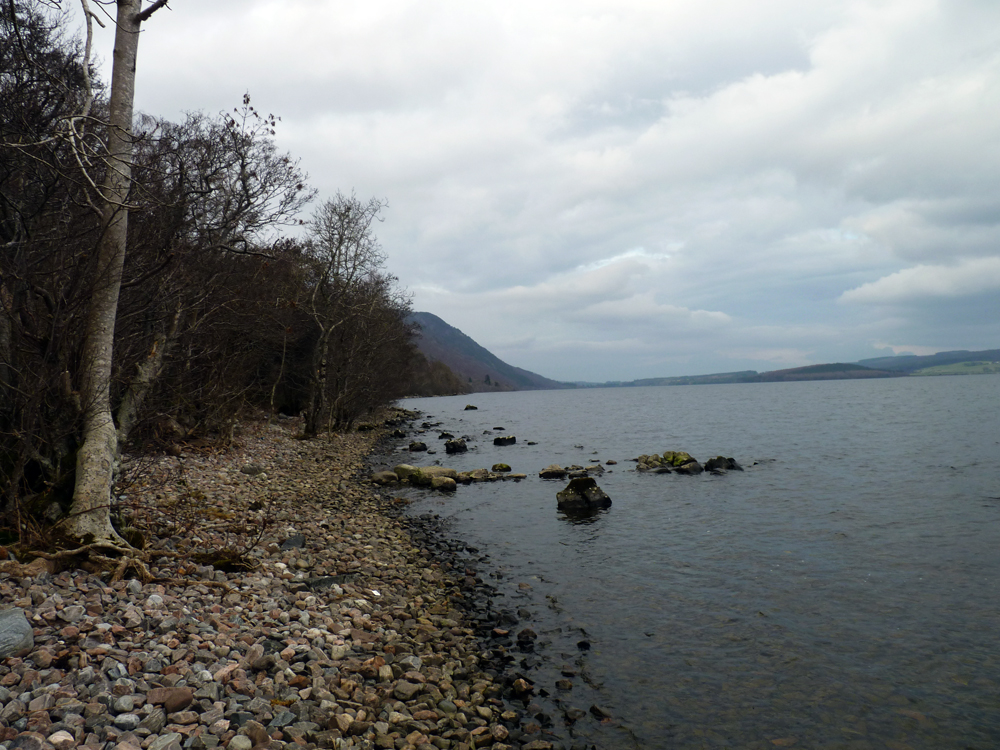
We headed down to the water with a bottle of whisky (as per the tradition!) and we enjoyed the view. This is the first part of the trip where I was so happy to have invested in a good pair of Wellington boots. I watched people trying to balance on rocks and eventually falling in, becoming soaking wet, and then I simply walked right into the water for my photo. 


We continued to Urquhart Castle, a medieval castle that is now one of the most visited historic sites in Scotland. Unfortunately, we weren’t able to go inside the castle, so we just hopped up a fence and took some photos until security came and told us to stop. 


Our next stop was a short coffee break, but it was where I saw my first highland cow! These cows are found throughout the highlands and are adorable.


Next, our bus drove through the mountains as our guide told us stories about the area. For example, there was one mountain that is said to be the site of a fight against the devil. The fighters tricked the devil, causing him to lose the fight and throw his fist in the air, shaping the mountain. 


Along we continued, through the mountains, where I saw some of the most beautiful sights I have ever seen. Although it’s been inhabited for thousands of years, the highlands really feel an untouched heaven.

Day two of the trip coming up soon!

Friday, November 26, 2010

Adventures beyond Stirlingshire Part 2: Off to Dunfermline

This part of my adventures tale takes us to Dunfermline, the former capital of Scotland.


According to Google Maps, it should take about 40 minutes by car from Stirling to Dunfermline. Unfortunately, lacking access to a car, we took the train, which had to stop in Linlithgow, then Edinburgh, and then Dunfermline, bringing us to a total of about two hours.

The view from Linlithgow Station
On the way, our train stopped for about 40 minutes, causing us to miss our connection in Linlithgow, causing us to miss our connection in Edinburgh. Thus, it took us more than three hours to get there.


We did get to take the train across the Forth Bridge, a famous rail bridge over the Firth of Forth, bringing us from Edinburgh to Fife. It's a very famous, recognizable bridge in Scotland.


A mosaic of the Forth Bridge on the Forth Bridge.
We arrived in Dunfermline around 3:00. Since most things closed by 4:00 or 5:00, we spent the better part of our time there taking photographs of the area.


Being in Scotland, it was raining quite a bit.


On the bright side, there was a gorgeous full rainbow, though I couldn't capture it completely in my photos.


Dunfermline has lots of beautiful gothic buildings, and it was wonderful walking around the streets. I think it was almost as beautiful as some areas of Edinburgh, although much smaller and not as exciting.


One of the most important buildings in Dunfermline is Dunfermline Abbey, founded in 1128.


It's a beautiful building, and I don't think I could ever get bored of walking along these historical structures. Every once in a while I stop and think about how long these buildings have been here, and how many important Scottish events have taken place here.


One significant part of this abbey is that it is the resting place of Robert the Bruce, an extremely important Scottish king who led Scotland through some of the years during the Scottish Wars of Independence. Sadly, the parish was closed by the time we got there, so I wasn't able to see his tomb which is located inside.


Although Bruce is buried here, his heart is buried in Melrose Abbey, in the Scottish borders.


I got some gorgeous shots of the cemetery. Despite the rain, I don't think I could have asked for a better day for photos.


Next, we went to Pittencrieff Park, an area put in place by Andrew Carnegie, an internationally famous philanthropist who was born in Dunfermline.


We visited his birth home, but no photos were allowed. It was a small but pretty 19th century home, with an expansion to include a museum that showed his many contributions. Most of these described the many libraries he funded in the UK, the US, and Canada.


There were so many little squirrels running around the park. I could only imagine how much fun it would be to walk there with my puppy in Canada, who goes crazy chasing them when they invade our backyard.


Tomorrow is the start of St. Andrews Weekend, in which a ton of heritage sites open their doors to the public for free. I will visit Edinburgh Castle and do a tour of the Edinburgh underground vaults. I'll also run walk up the 246 steps of the Wallace Monument and visit Stirling Castle before the free days end on St. Andrews Day, which takes place on Tuesday.

Then, I have just four more days before I head down to London for a month-long internship at the CBC London Bureau. I definitely have an exciting month ahead of me!